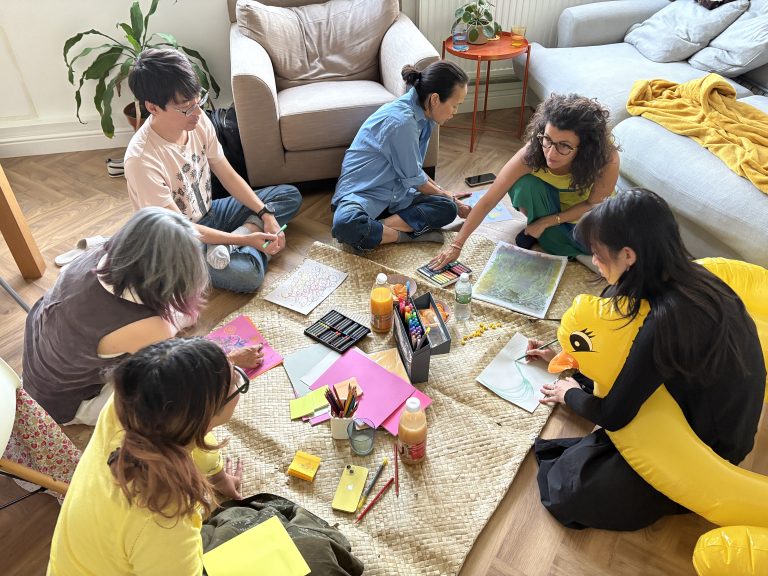
In the first workshop, I explored how relational access became visible through the shared mat through gestures of hosting, noticing and responding to one another in the space of a meal. People passed dishes, shifted slightly to make room and sometimes sat quietly before speaking. Attention moved through the room in small ways.
But attentiveness does not only unfold through physical space. It also emerges through listening.
Listening asks for a similar kind of awareness, of noticing tone, rhythm and interpretation as they shift between people. Meaning does not always arrive fully formed. Often it emerges gradually, through response and adjustment.
With this in mind, I wanted to explore how relational access might unfold through sound.
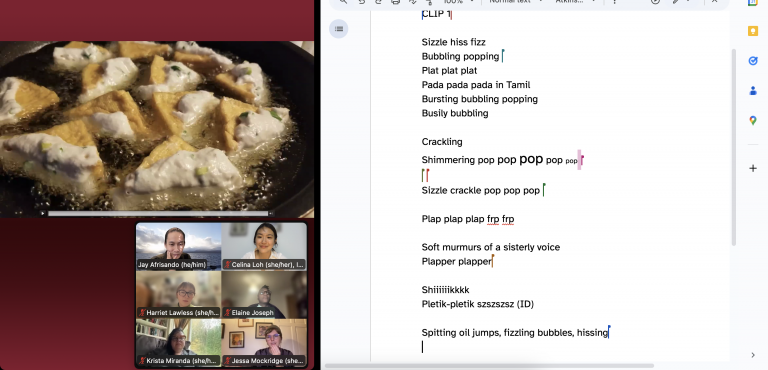
Together with artist Jay Afrisando, we ran a workshop that invited participants to listen to everyday sounds from Southeast Asia and describe what they heard.
At first the task seemed straightforward. A short recording played and participants began typing captions into a shared Google document. Words appeared quickly on the screen – fragments of description, onomatopoeic sounds, attempts to capture its pace or tone.
Then someone edited a phrase. Another person added a second interpretation. A caption expanded into two possibilities. The document slowly filled with overlapping descriptions.
What initially looked like a simple captioning exercise began to shift into something else, a collective attempt to make sense of sound together.
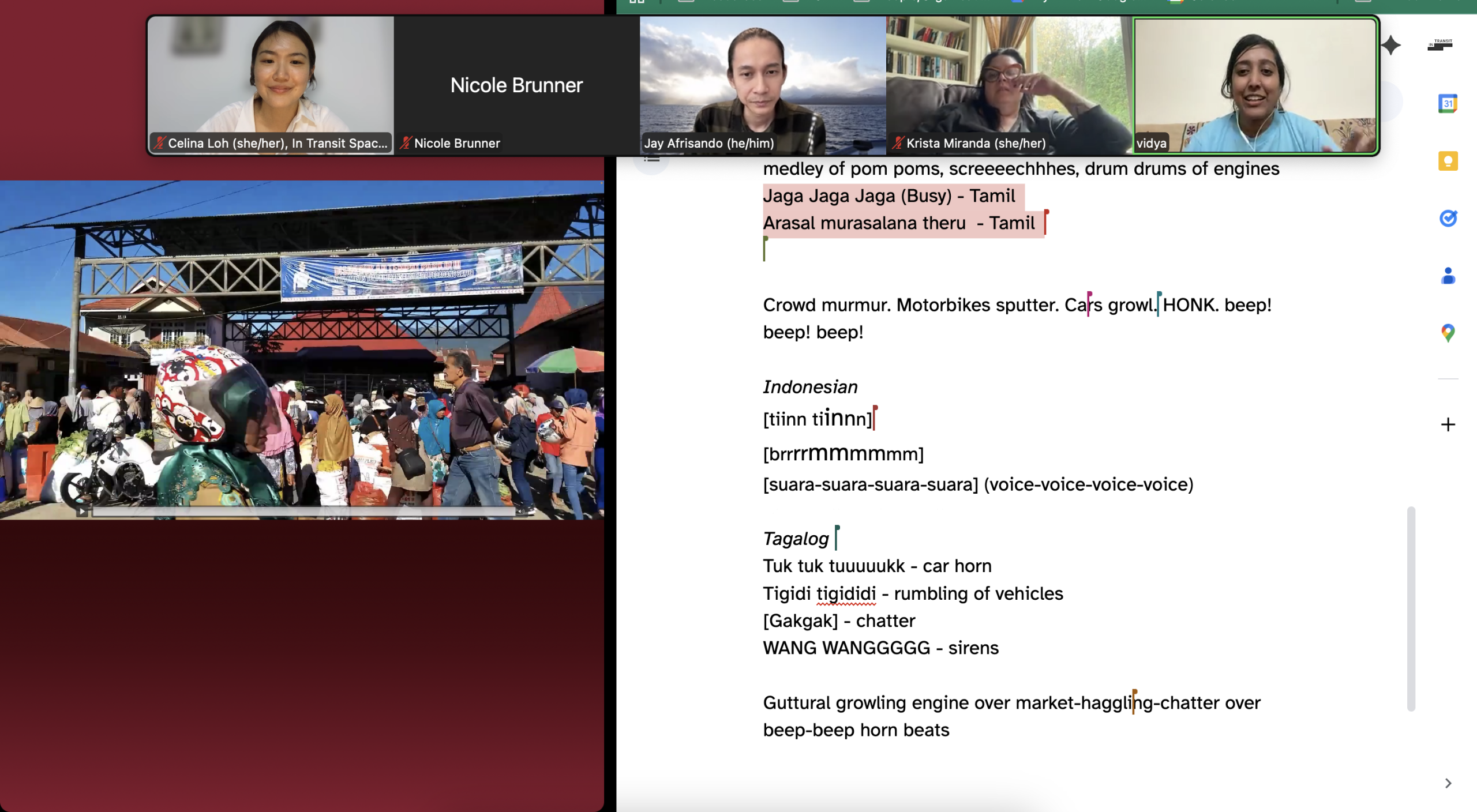
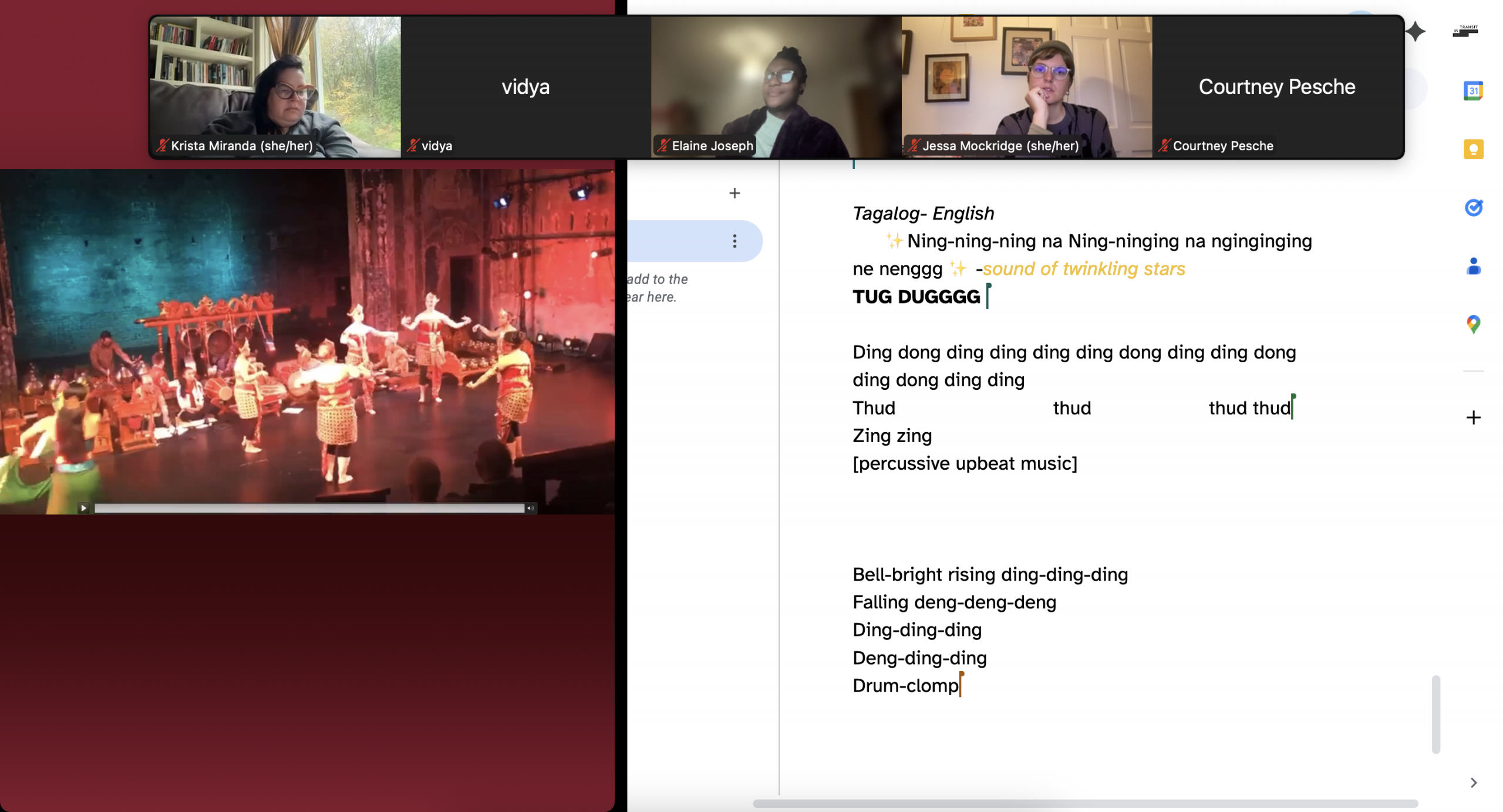
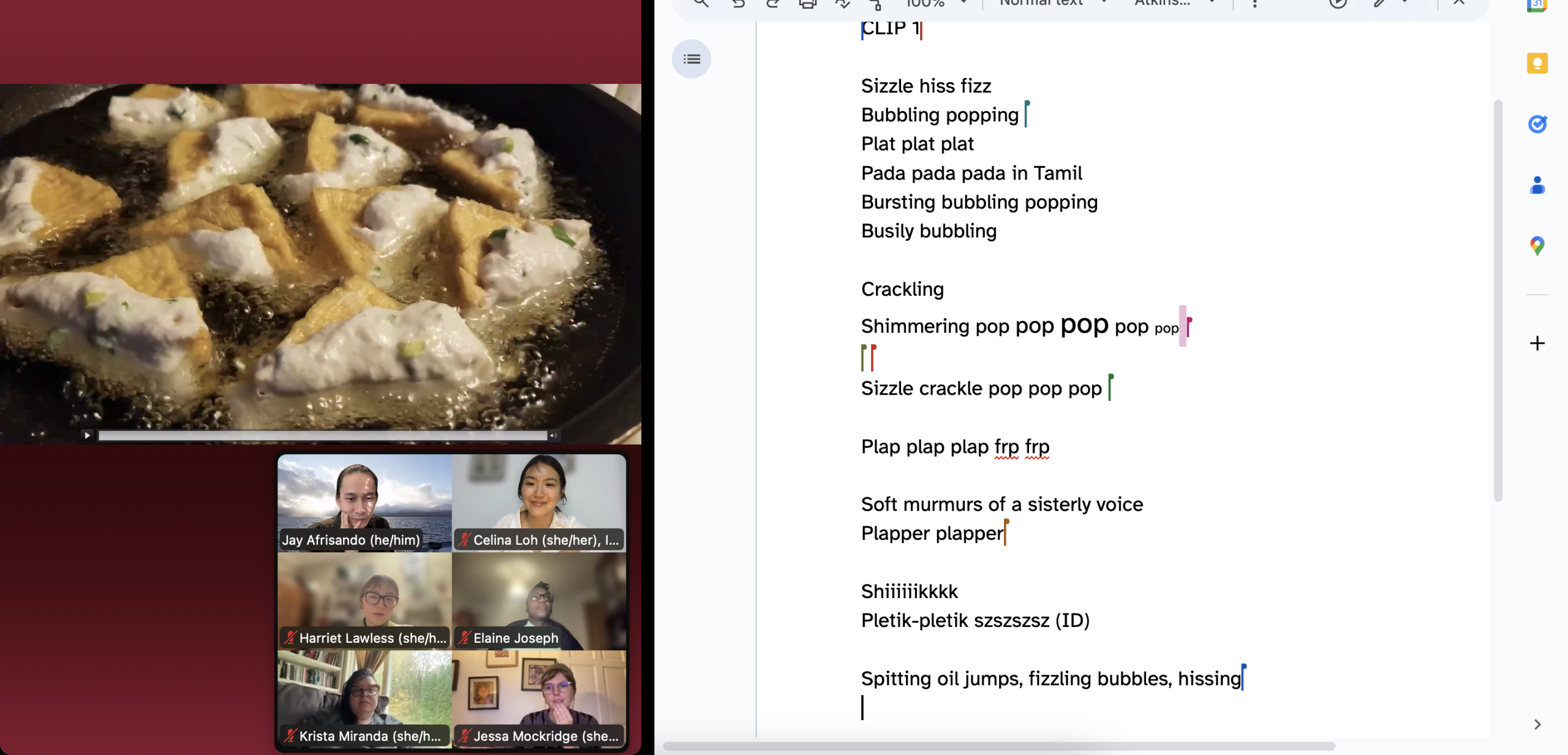
The recordings included everyday sounds: traffic passing through a street, voices in the background, fragments of conversation. Participants listened, typed, paused and listened again.
As captions began appearing in Tamil, Filipino, Thai and English, subtle differences in interpretation became visible.
In Thai digital culture, ‘555’ reads as laughter, because the number five is pronounced ha. Someone typed it into the document and a few participants laughed when they recognised it.
What looked like numbers on the screen suddenly carried humour. Other sounds produced slower conversations.
Even something as ordinary as a car horn prompted discussion. In Indonesia, several participants referred to the sound as klakson. In Malaysia – despite the linguistic similarities between the two countries – the term is rarely used in everyday speech.
The difference was small but revealing. Sounds that seemed straightforward at first began to open into multiple interpretations. What felt obvious in one context carried different associations in another.
Listening across cultures therefore often begins with uncertainty.
Listening through bodies
Participants did not only listen through their ears.
Some replayed the recordings several times while watching the captions appear on the screen. Others paused between words, adjusting their descriptions as new interpretations emerged.
The visual layout of the captions began to matter as well – the spacing between words, the size of the text, the way certain sounds stretched across the page.
These details shaped how the sounds were understood.
Listening, it became clear, is not purely auditory. It also unfolds through bodies, through gesture, visual cues and timing. My own experience of listening is one of many ways people navigate sound through a combination of sensory, visual cues rather than hearing alone.
Listening involves multiple forms of attention.
As the exercise continued, participants began to slow down their captions. Instead of searching for the ‘correct description, they started asking each other how a sound was heard in different languages.
Someone paused before translating a phrase and asked whether the humour would carry across languages. Another participant suggested leaving two interpretations side by side rather than choosing one.
The captions became layered. Translation gradually shifted from a technical task into a relational process.
Participants were no longer only describing sounds. They were also considering how their interpretations might affect others in the room.
Translation became a way of listening carefully enough to allow different meanings to remain visible. No single caption could fully capture how a sound might be understood across languages and cultural contexts.
Sometimes the most attentive response was simply to leave space for multiple interpretations.
Listening and power
At the same time, the exercise revealed that collaboration does not automatically produce equality. Although the document was shared, some voices naturally appeared more frequently than others. Certain interpretations gained momentum while others remained quieter. Even within an open editing space, participation still required active facilitation.
Listening, like hosting, carries its own dynamics of power.
Whose interpretations are noticed?
Whose explanations shape the final caption?
These questions surfaced gently during the exercise, reminding us that accessibility is not only about providing services but about cultivating environments where different perspectives can genuinely influence the process.
Over time, the workshop began to resemble the dynamics that had appeared during the Shared Mat session. Participants offered interpretations and responded to others, adjusting their descriptions as new perspectives emerged.
Misunderstandings did not feel like mistakes. They became moments that invited further listening.
Across both workshops, the shared mat and the captioning exercise, relational access appeared less as a fixed framework and more as an evolving practice. It emerged through small acts of attention – noticing a pause, adjusting a caption, asking someone how they heard a sound.
Access, in these moments, was not delivered in advance. It was something people created together, through the slow work of listening.
This research by Celina Loh draws on Southeast Asian communal practices such as eating together as a starting point to explore how relational approaches might complement structural access frameworks in the UK arts and cultural sector. Beginning with shared meals, the work expands into collaborative listening, sound and facilitation practices, reflecting on how care and attentiveness circulate within creative environments.
At its centre is a simple question, how do people create conditions where others want to remain? Through workshops, shared meals and listening practices, the research explores how participants notice one another, adjust and begin to host each other. While access often takes shape through structures, this work considers how it is sustained in practice through the ways people respond and make space for one another and themselves.
Loh’s research is supported by the British Art Network (BAN). BAN is a Subject Specialist Network supported by Tate and the Paul Mellon Centre for Studies in British Art, with additional public funding provided by the National Lottery through Arts Council England.