With the rise of accessibility in audiovisual media, we are seeing an increasing number of ways to caption sound, some of which have become standards or conventions that help captioners tackle common challenges in interpreting sound through words. Nonetheless, each captioning context may be unique, and languages may influence the way we think of and describe things.
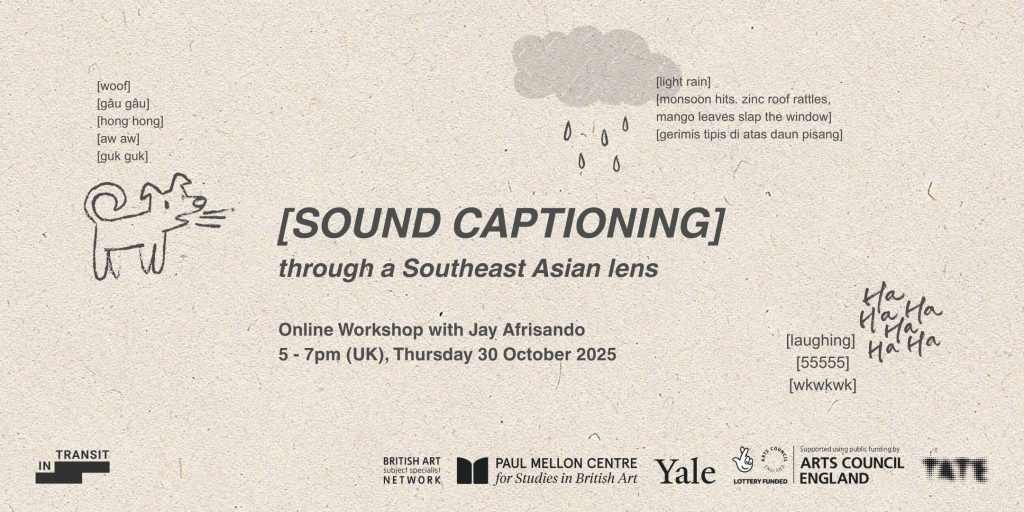
This workshop will bring participants together to collectively consider how the languages of Southeast Asia (SEA) influence sound captioning. How do cultural contexts, words and the language’s set of rules shape sound captioning? Are there any differences in sound captioning when aurally diverse (Deaf, Hard-of-hearing, neurodivergent, ‘normal’ hearing, etc.) Southeast Asians bring their embodied experiences into consideration? Can SEA (and other non-English) perspectives form a new aesthetic in sound captioning?
The workshop will build on collective knowledge of sound captioning in non-English contexts.
In the workshop, participants will:
- learn sound description and its contexts through SEA language(s) the participants use/know
- observe the possibilities and challenges in describing sound through SEA language(s)
- recognise the dynamic relationships between text, sound, and other sensory experiences, such as visual, tactile, texture and temperature, among others, through SEA perspectives
- learn how to caption in different media contexts and needs
Access info
- This workshop is open for English-speaking participants who also speak in any language in Southeast Asia (Indonesian, Malay, Singlish, Thai, etc.). However, the workshop also welcomes those interested in sound captioning in non-English contexts.
- The workshop will be delivered in spoken English with live captioning/CART (Communication Access Realtime Translation) in English.
- Participants will communicate their non-English sound descriptions via an online document provided throughout the workshop.
Artist Bio
Jay Afrisando is a composer, multimedia artist, researcher, and educator. A neurodivergent, he works on aural diversity, disability, accessibility, and decolonizing arts through multisensory and antidisciplinary practice, manifested in music-theater, film, installation, witty storytelling, and other genre-bending experiences. Some of his (collaborative) works use creative captioning as an artistic resource, including “[opera captions]” (2023-25), “In Which to Trust?” (2022-23), “Cards Against Neurotypicality” (2025), and “Time Bent, Folded, Exhausted” (2025), among others. He is a 2024-25 DAAD Artists-in-Berlin Fellow and Assistant Professor of Music at the University of California, Santa Cruz.
About the workshop and its wider research
This workshop is part of Celina Loh’s (In Transit Space CIC) ongoing research on how Southeast Asian cultural practices can expand existing Eurocentric access frameworks that tend to focus more on policy, compliance and individual accommodations. She uses Southeast Asian communal practice of eating together as a methodology to investigate how relational approaches can enrich UK structural access frameworks, fostering togetherness, mutual hospitality and belonging.